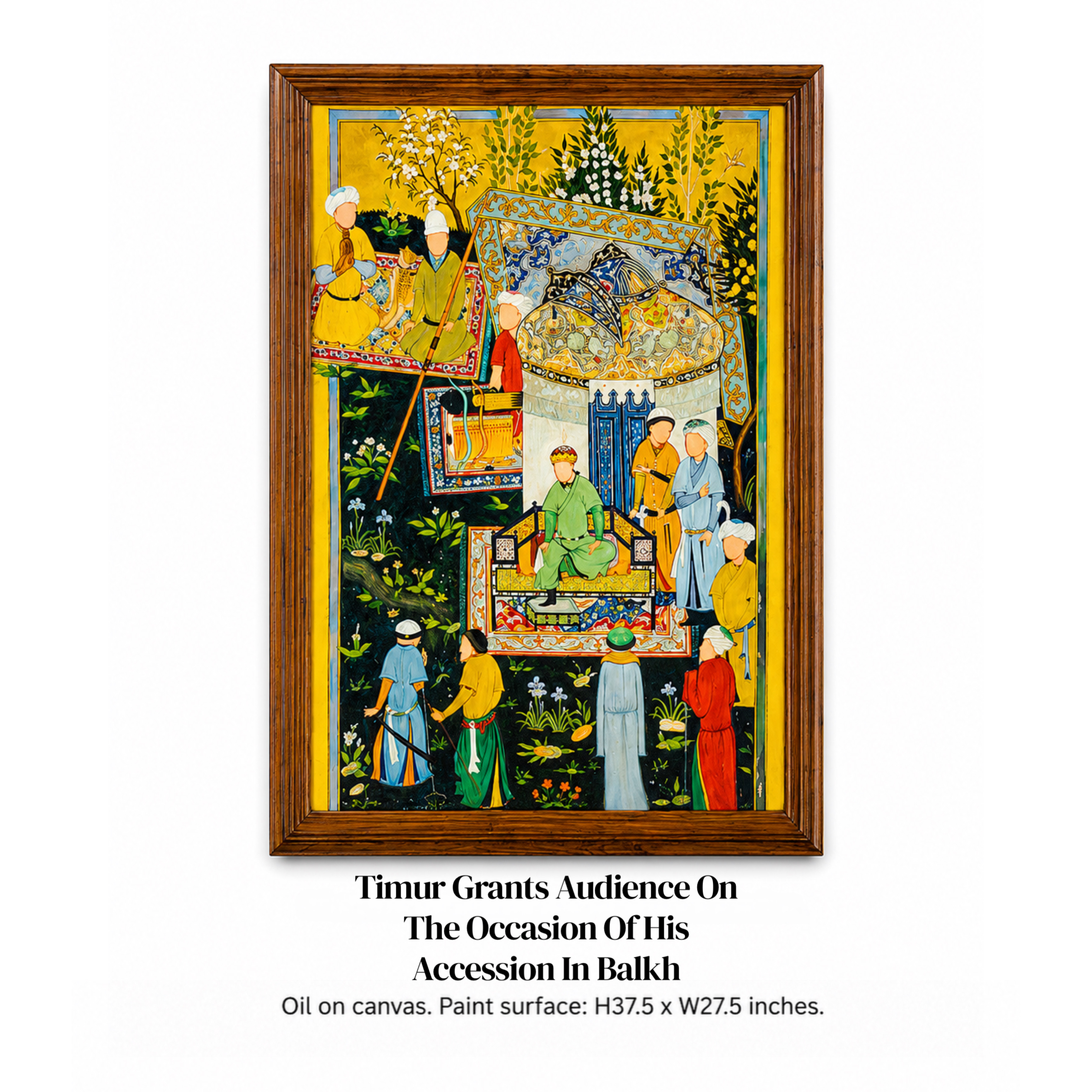
As was tradition, upon ascending to power, sultans expected all their ministers, generals, and dignitaries to come to the palace and show fealty to the new ruler.
The Zafarnama, or “Book of Victories,” is a panegyric written by Sharif al-Din ‘Ali Yazdi about two decades after Timur’s death. Commissioned by Ibrahim Sultan, Timur’s grandson, between 1424 and 1428, it is a well-known source on Timur’s life.
There is debate about who painted the illustrations in the Zafarnama for Sultan Husayn. Originally attributed to the master painter Bihzad, some scholars doubt this, as he would have been a young, inexperienced artist at the time. While the paintings may date back to the conquest of Herat, it seems unlikely that such an important commission would be given to someone so young. Others argue that the youthful style and emotional depth of the artwork reflect Bihzad’s developing skill and justify his attribution. Additionally, Bihzad was likely familiar with Yazdi’s work, as he references it in several of his own creations, leaving open the question of whether he was the actual painter or simply inspired by the manuscript.